
MYSK
Quiet-Voice Engine
Scroll
MYSK
Scroll
II
A pair of AI glasses with a camera, that also records offline.
12MP 4K photos · offline recording, no network needed · three sizes · any prescription

Photographs.4K stills. One press, with no phone to fish out, nothing to unlock and no app to open.
Recording, with no network.Written to the glasses' own storage, never touching a network. No signal in the hills, phone off in a plane — it records anyway.
Two microphones, both on the frame.The main one sits at the centre of the lower left rim, port facing down towards your mouth, 4–7 cm away; the reference one sits at the top of the right rim, port facing up and away, much further from your mouth. Which is why you can speak very quietly.
Two speakers.In the temples, near the ear and aimed at the canal. Music, podcasts, phone calls — like any pair of Bluetooth earbuds.
It is a pair of glasses first.A TR90 frame on ordinary optical geometry, UV400 lenses, and any prescription — myopia, hyperopia, astigmatism. When the sun is out you were going to wear it anyway.

AI glasses with cameras exist. Audio glasses that record exist. A pair that does both, with recording that depends on no network at all, is at present only this one.
What those other glasses call recording is really lending a microphone to a phone — no phone, no signal, aeroplane mode, and nothing is kept.
Ours is written to the glasses' own storage. No Bluetooth, no network, at any point. No signal in the hills, none on the underground, phone off in a plane — you press, and it records. Sync when you are back.
The same reasoning holds for photographs: shooting does not need the phone. The glasses keep it and hand it over later.
The main microphone sits at the centre of the lower left rim, port facing down towards your mouth. Faces differ in size, so that distance is 4 to 7 cm.
The reference microphone sits at the top right of the right rim, port facing up and tilted back, away from your mouth. About twelve centimetres.
When you speak, your voice reaches the main microphone 7 to 9 dB louder than the reference. When someone half a metre away speaks, the two are almost equidistant from them and the difference is under 1 dB. The threshold sits at 4–5 dB, and anything below it is never written.
That is the whole privacy design. No DSP, no beamforming, no voiceprint, no model, no added cost. It cannot be switched off either — because it is not a switch, it is where the ports are.
Worn, it is 4–7 cm. Taken off and held to your mouth, 2–3 cm. Same microphone, one movement.
Geometry beats any noise-reduction algorithm.
One microphone towards the mouth, one facing away.The decision is the difference in level between them. Walking down a street, sitting in a café, on a video call — the same result: what is recorded is only you.
You can be very quiet.Quiet enough that someone half a metre away cannot hear you, and it still captures you clearly.
Which is why it cannot record a meeting.A few people brainstorming, an interview, a lecture — this pair cannot do it, and a voice recorder should. That is not a flaw, it is the other face of the same decision.
An online meeting, though, it can.If you want your own half of what was said kept separately, this is exactly right — what it records is the part you spoke.
Not "it can also take a picture". Every trade made on this pair — which chip, which sensor, which lens, whether to do long video at all — was settled by that one question.
Whether a photograph is any good comes down to three things and only three: the chip, the sensor and the lens. Each one is below, with what we chose and what the choice bought.
A quad-core CPU and 4 TOPS on-device. Neither number is what matters, though — what matters is which jobs it does in silicon.
AI-ISP.Noise reduction, wide dynamic range and colour are settled at the moment of capture, not repaired afterwards. This is where the same sensor on two different chips ends up a class apart.
PDAF phase-detect focus.Raise your hand and press; no hunting. Most photographs taken on a pair of glasses are snatched, and a slow focus means the moment is gone.
Electronic stabilisation.You are walking while you shoot, not bracing.
4K encoding.Enough for stills and for five-second clips, with headroom left over.
On a sensor this small, pushing the pixel count up is the easiest thing to do and the least useful.
And how much light a single pixel catches decides the noise in low light, and how much of the highlights and shadows survive together. Twenty megapixels in the same area means every pixel catches half the light. A better spec sheet, a worse photograph.
So we spent the budget in the opposite direction: a larger pixel. Cleaner in daylight, cleaner still at dusk and indoors.
A 4K photograph out of 12 megapixels is more than enough on a phone, on a social platform, or printed at six inches. What actually makes you say "not this one" was never resolution: it is noise, a blown-white sky, a smeared shadow — and all three belong to the sensor and the chip, not to the pixel count.
No pixel race and no long video means an order of magnitude less data. Storage can be smaller, power lower, the battery smaller — and the end of that chain is a pair you wear all day without wanting it off.
Glasses do not need a zoom: turning your head is the zoom. A zoom means a motor, a longer barrel, more moving parts — all three add weight, all three drink power, all three are things that break.
Take it out and the group can be thinner, lighter and stronger, and the optical path easier to get right. A very good subtraction.
Because you have no viewfinder. Raising your hand and pressing, you are not sure where the edges are — go wider and you will not cut off half a head. Get it first, crop on the phone. Cropping is possible; putting it back is not.
It decides whether dusk, indoors and under the trees — the "not very bright but I want this" moments — are usable at all. However good the sensor, it cannot work on light that never arrived; the two have to be given together.
All-plastic elements are cheap, but the edges go soft and fringe purple. Glass elements push both down, at the cost of a little money and a little weight. On a pair of glasses meant to come home with photographs, we will pay that.
This is an original way to think about the product.
4K stills.There is one action on the glasses: take a photograph. Press when you want it; everything else happens on the phone.
Interval shooting, cut into a sequence.Set it on the phone — one frame every three seconds, say — and it keeps going by itself. What comes back has a rhythm, rather than an hour of footage nobody watches twice.
Five-second clips.There when something has to move. But no long video — that is not what a pair of glasses is for.
Why no 4K recording.Continuous video will not fit, costs far more power, and shakes for as long as you are walking. Interval frames aligned on the phone come out far steadier.
And storage is going up this year.What eats storage is precisely continuous 4K. Leaving it out saves more than space — it saves real cost, and that lands on the price you pay.
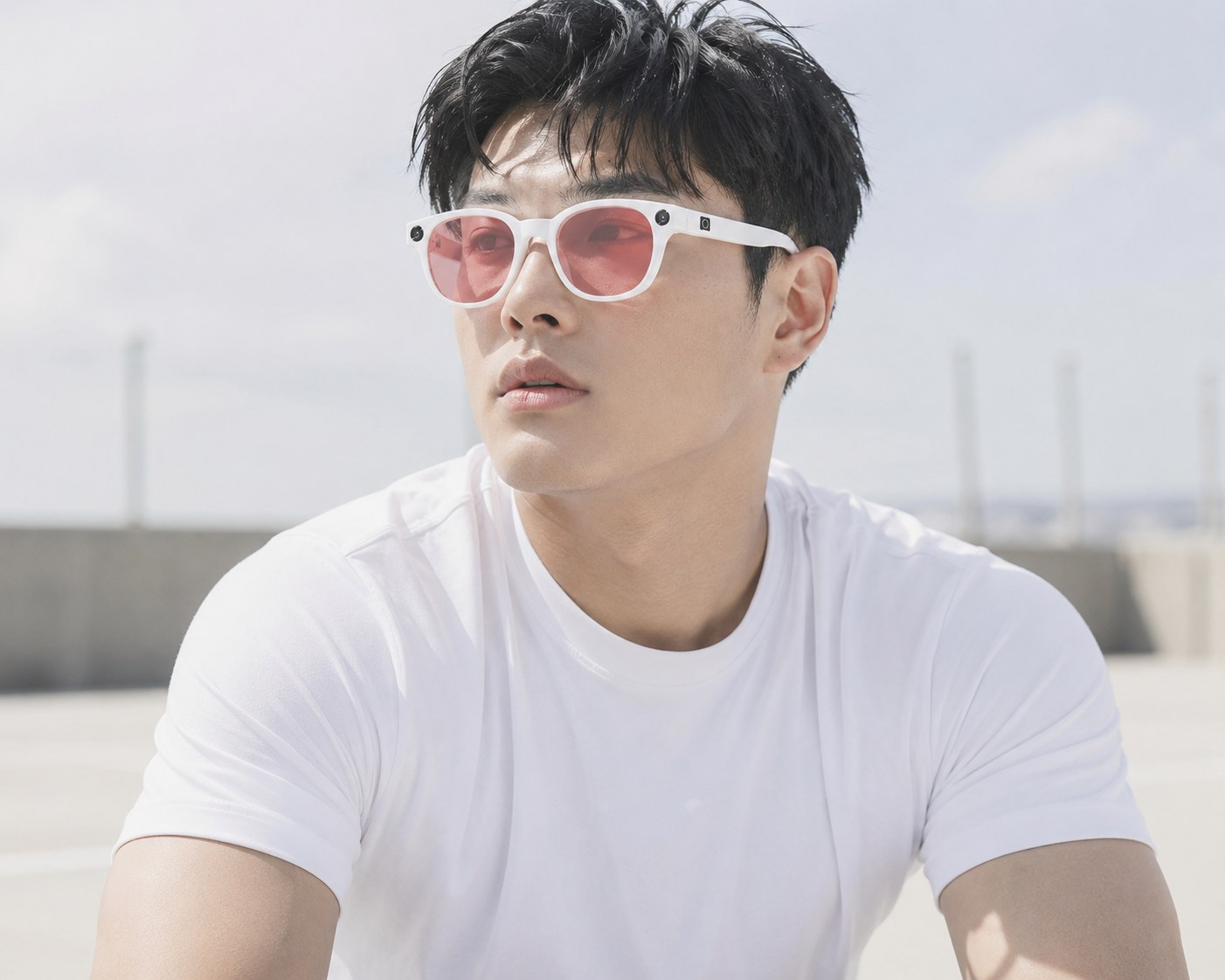
Frame, temples, hinges, nose pads — all built the way the high-end sports and children's eyewear sold in the United States is built. Strip every electronic part out and it is still a four-figure pair of glasses — one that holds up indoors, and outdoors in sport.
The temples are 6.5 mm thick.Thin, and wide — the feel of a fashion sunglass temple. Thin so it does not look clumsy, wide so the electronics can be laid out flat instead of piled into a bulge.
The wide temple solves something else on the way.It shades the outer corner of the eye. Ultraviolet arriving from the side is the part most glasses miss, and a wide temple simply blocks it.
But we do not wrap it.A wraparound like a pair of goggles would seal the eye better, at the price of a frame that has to be thick and heavy. This is where we struck a balance: block what should be blocked, without stacking weight on for the last few per cent.
A TR90 frame.The nylon used in high-end American outdoor sports eyewear. Very light, very resilient, and it springs back under load instead of deforming. Not the cheap plastic the word "nylon" brings to mind.
Hinges to sports-eyewear standards.The small size especially — on children's glasses, almost every real breakage happens at the hinge.
Soft on skin.Liquid silicone, which leaves no mark after hours on the bridge.
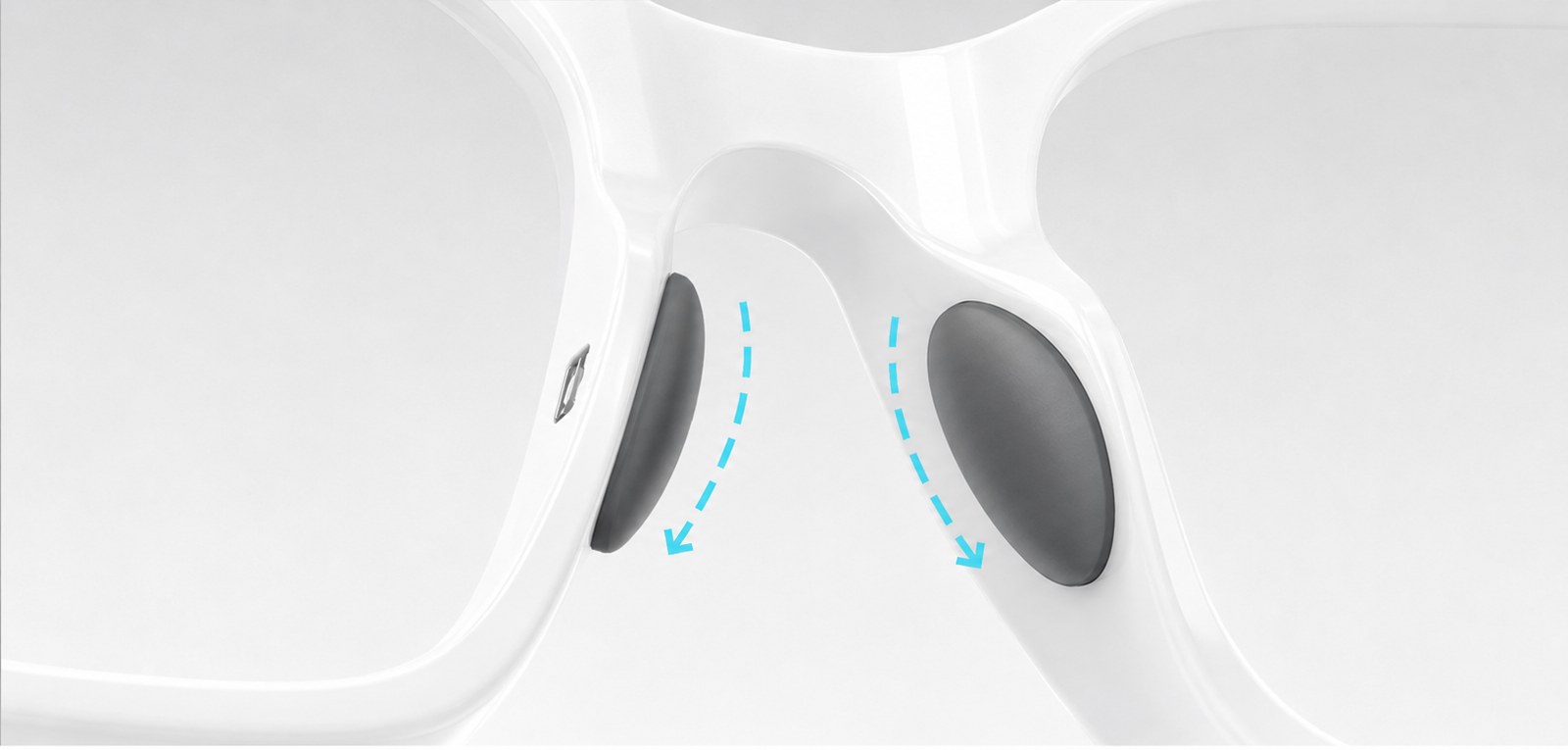
More grip once you sweat.Ordinary pads start sliding the moment you sweat; these do the opposite — wet, they hold better.
Pressure spread evenly.An air-cushion structure has far more contact area than a hard pad, so the weight is not carried on two points.
Two heights, swappable.Bridge height varies enormously between people, and one size cannot suit them all. So it is a replaceable part, and both are in the box.
The same white as the classic Apple phone white, and the same baked finish that produces it.
Why only one colour.Putting the whole effort behind one colour at launch is what keeps the finish consistent. Baking one colour and baking five are not the same job.
Why white.White is the hardest on the process — a shade off, a touch of orange peel, a little paint pooled at an edge, and none of it can hide on white. It is also the easiest colour to wear with anything.
Other colours will come.Just not in this first run.
What comes with it by default is one plano light-red-gold lens. The aim is for that pair — white frame, light red gold lens — to become the mark of our community, and its culture.
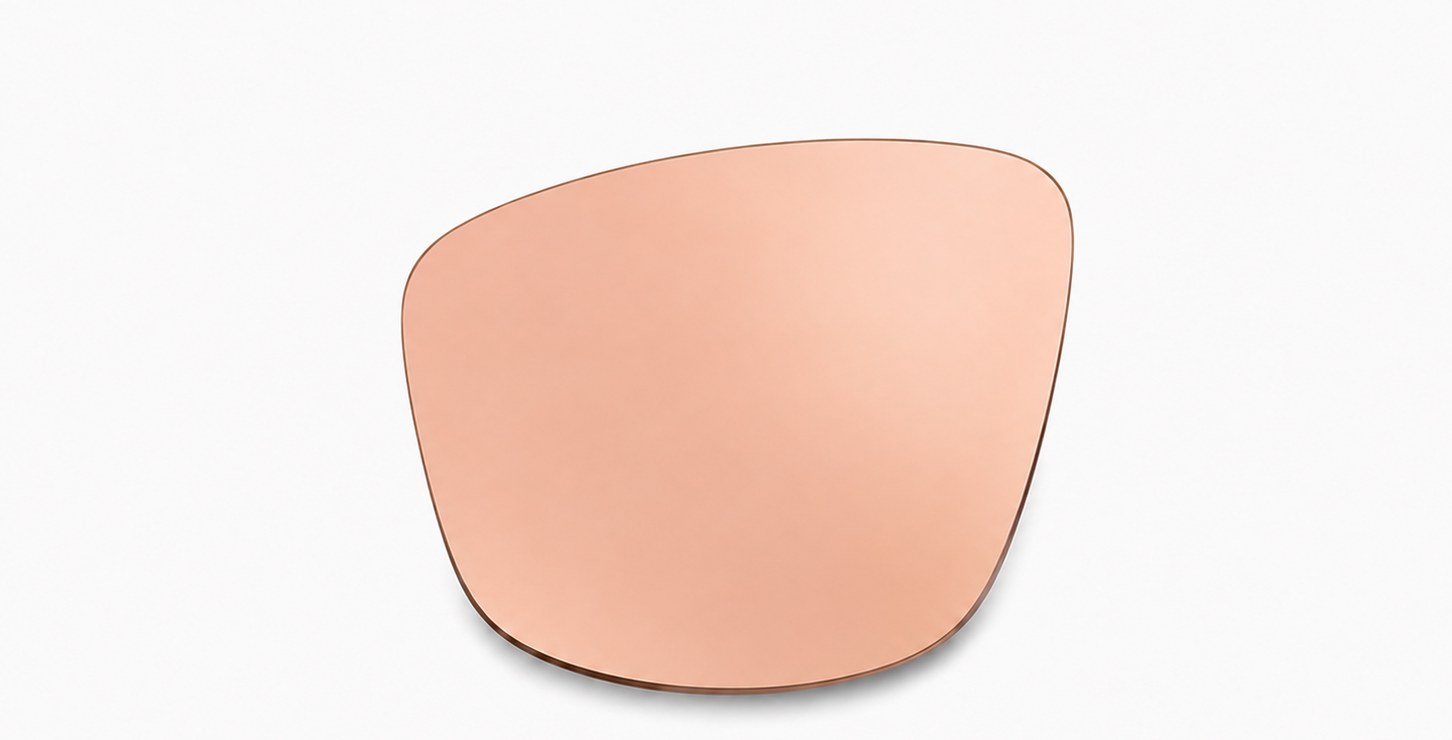
It is Trivex.One of the finest lens materials there is. The best impact resistance, which is why American children's and sports eyewear uses so much of it; also lighter than ordinary resin, with less optical distortion.
A pair of lenses in this material is ¥400 to ¥800 at an ordinary optician.Which is to say the lens that comes with our AI glasses is already worth ¥400 to ¥800.
Another colour, or a prescription, is paid for separately.The prices are below.
Why two extra moulds are worth it.Glasses are not earbuds. This rests on your nose, sits on your ears and stays on all day — three millimetres of difference is the difference between wearing it for a day and wearing it for ten minutes. Flexible temples rescue part of that; they cannot rescue frame width or bridge width.
On top of the three sizes there are flexible temples.So the real coverage is a little wider than the table says.
And the smallest one lands exactly on a child's face.Not opened up here — it is at the end of the page.


| Size | Dimensions | Guide age | Head | Face width | Who it suits |
|---|---|---|---|---|---|
| S | Frame 132 × 42mm lens width 48mm bridge 17mm temple 130mm |
Children 6–12 some smaller-headed teenagers |
48–54 cm | 115–132 mm | School-age children, teenagers with smaller heads |
| M | Frame 149 × 50.6mm lens width 53mm bridge 21mm temple 157mm |
Teenagers to adults | 53–59 cm | 130–150 mm | Most adult men, the large majority of adult women |
| L | Frame 163 × 57mm lens width 56mm bridge 22mm temple 165mm |
Adults with larger heads | 57–63 cm+ | 145–165 mm | Adults with noticeably larger heads and wider faces |
The hardware is identical in all three; only the size differs. Every dimension above was measured by hand and may be slightly out. If you are unsure which to take, measure your head, or send us the string of numbers printed inside the temple of the pair you wear now.
Three sizes handle how big it is. This section is about three other things — none of which sizes solve. They are solved by the shape, the nose pads and the colour.
European and Asian faces both wear it.The biggest difference between them is not head circumference; it is bridge height and facial depth. Which is why the nose pads are replaceable — a high bridge takes the low pad, a low bridge the high one, and the same frame lands in the right place on either face, without sliding down and without touching the lashes.
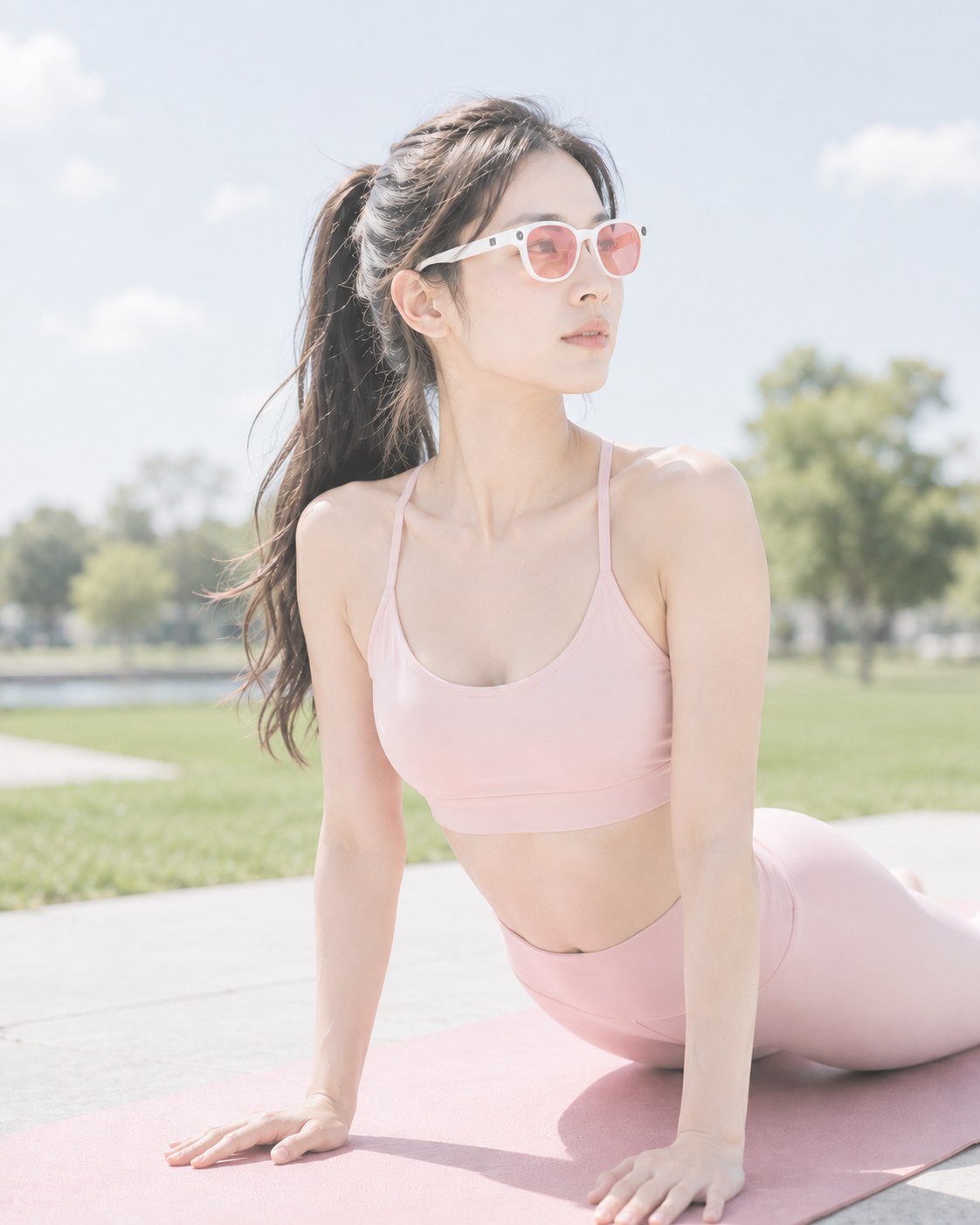
It suits men and women alike.The shape runs the line between round and square: no sharp cat eye, no hard rectangle. Add three sizes, and the same design reads as a different character on a different face, rather than one pair forced onto everyone.
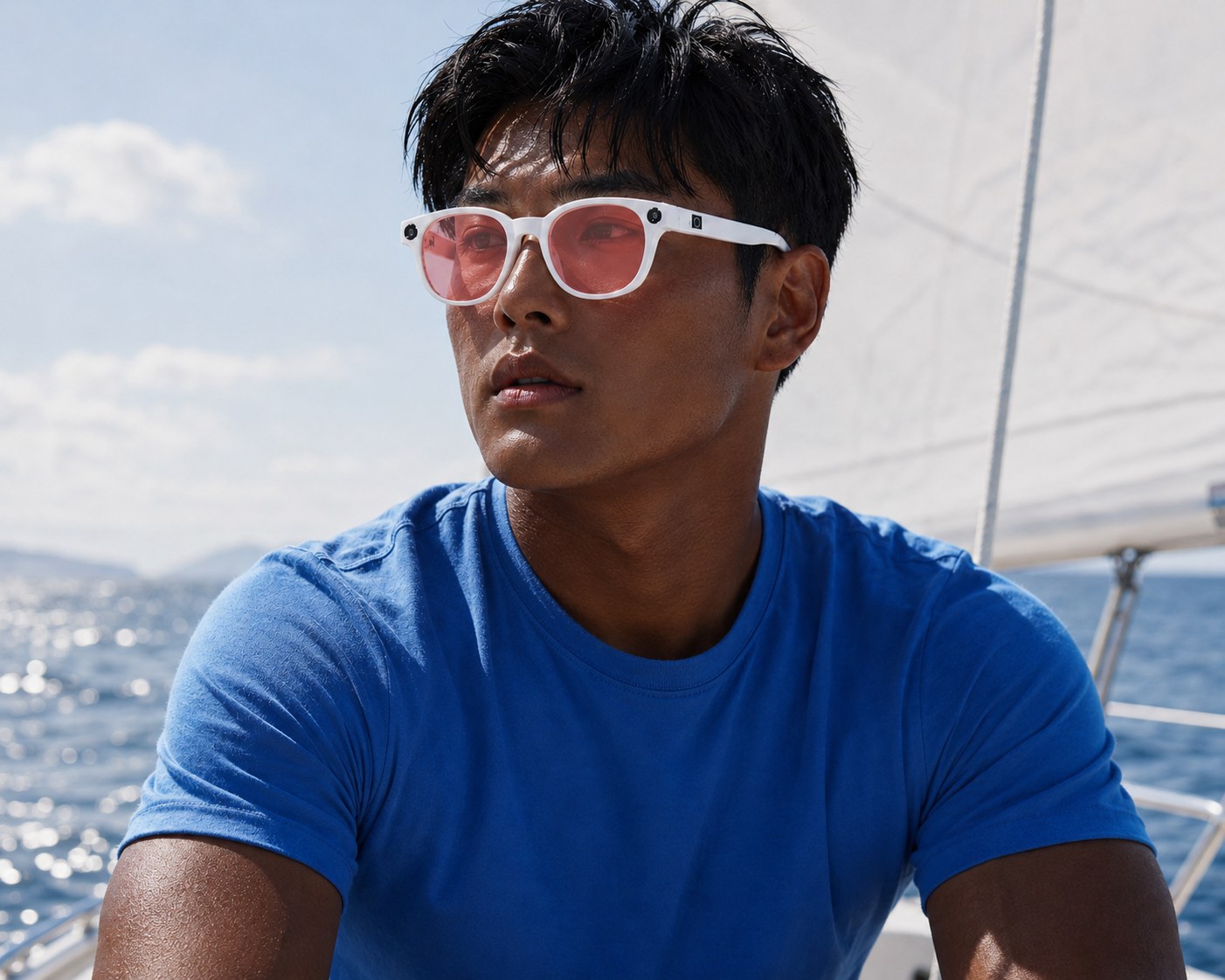
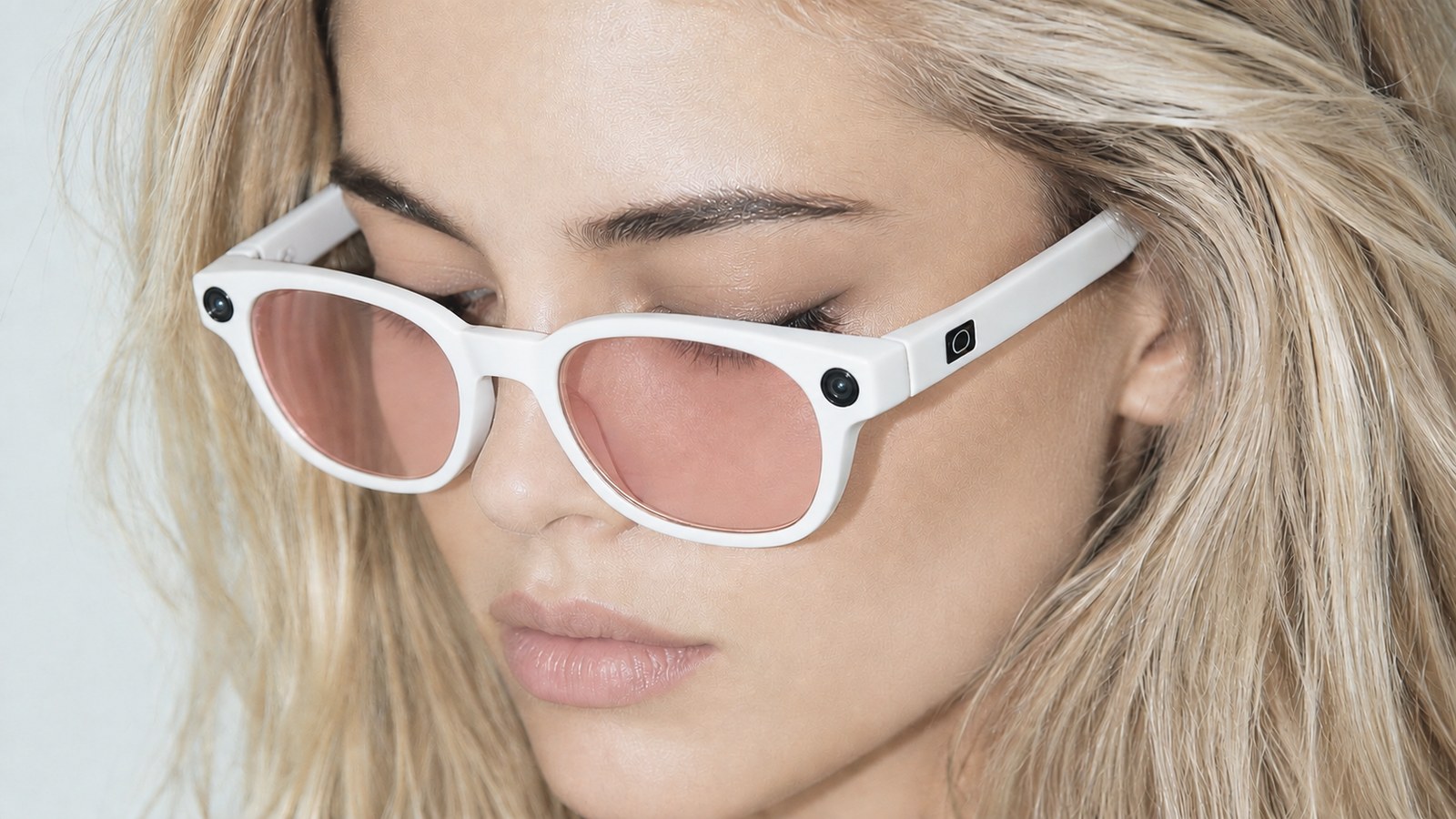
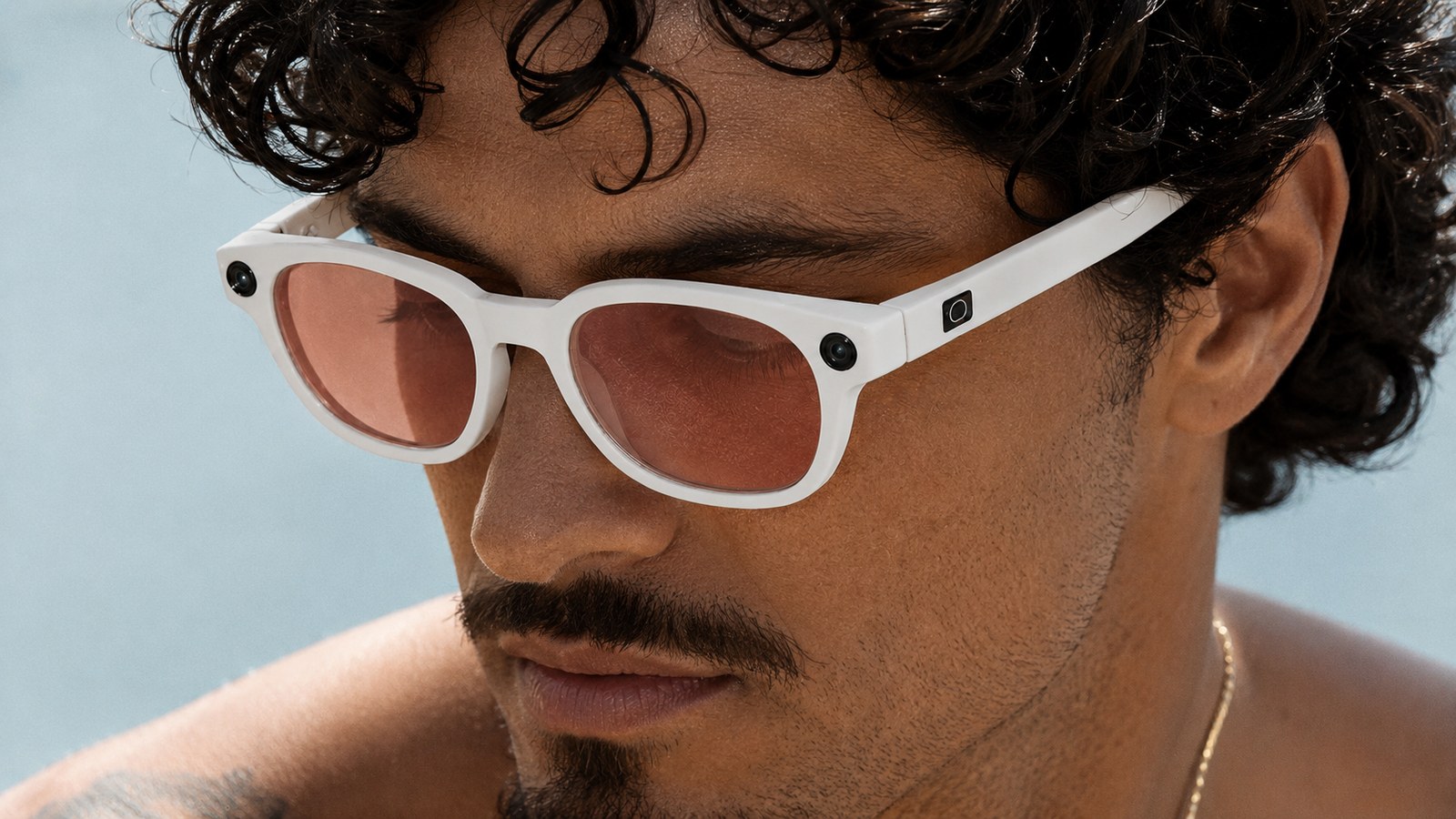
Any skin tone.A white frame is the safest choice here — it does not play the contrast game against skin at all. Pale or dark, a white frame simply frames the face cleanly. And light red gold is a warm colour, which lifts any skin tone rather than weighing it down.
One pair of glasses, many faces.That is not a pleasantry. It is what we got by putting three sizes, replaceable nose pads and a neutral shape together. Any one of them alone would not have been enough.
An Asian face, strong sun.On a lower bridge, the high pad keeps it from sliding — most visibly once you sweat.
A European face, pale skin.A white frame makes no hard contrast against pale skin; it just frames the face.
A deeper skin tone.A dark frame is easily swallowed by the face here; a white one is not. Light red gold is warm, and it lifts rather than weighs down.
A woman in the same design.There is no women's version. The shape runs between round and square, and on another face it reads as another character.
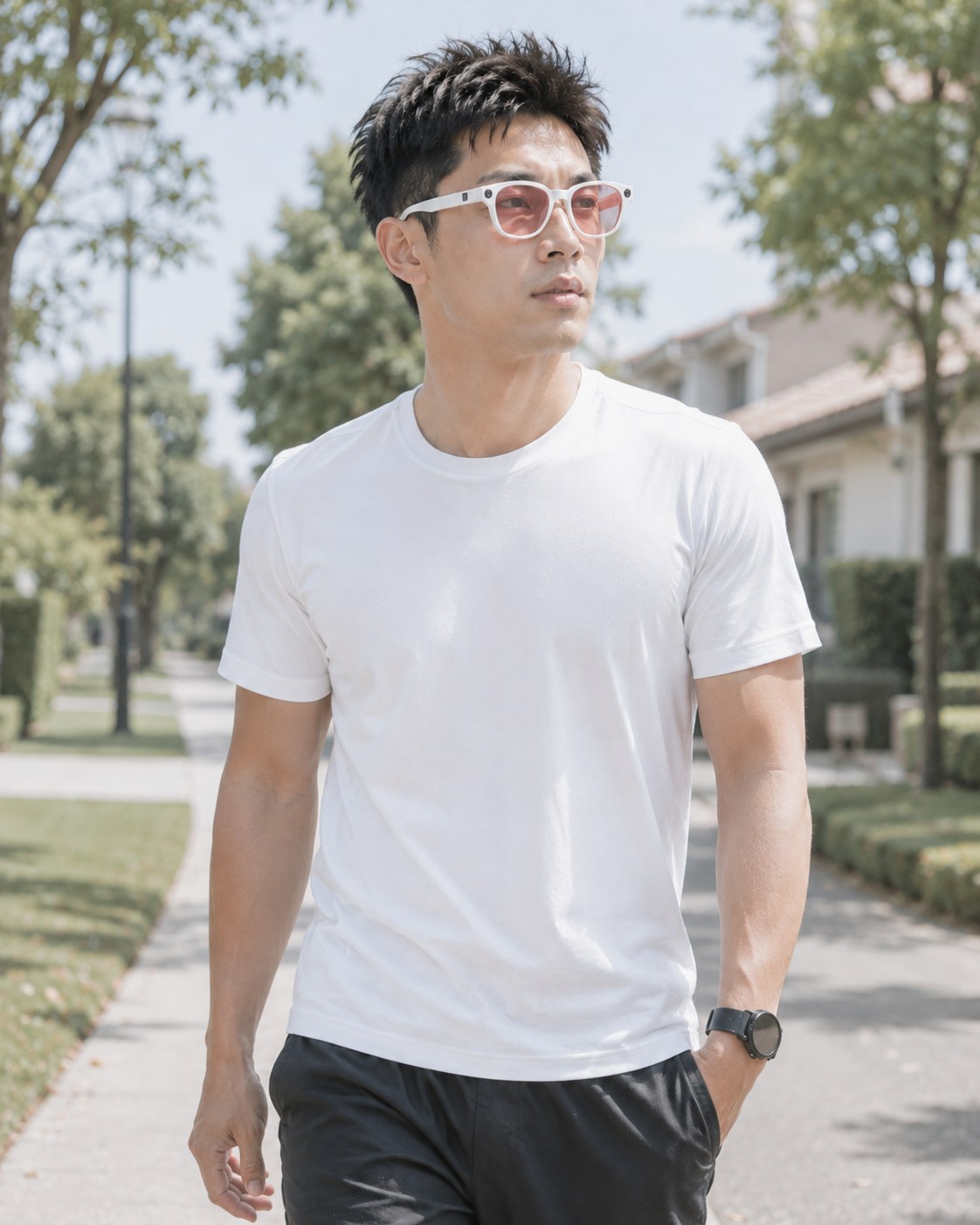
White on white, still no argument.The great advantage of a colour that stays out of the contrast game is that it does not mind what you put on today.
Because our frame is built on ordinary optical geometry, not as a sealed part that only takes a factory lens. Walk into any professional optician with it, and everything they can do, they can do on this pair.
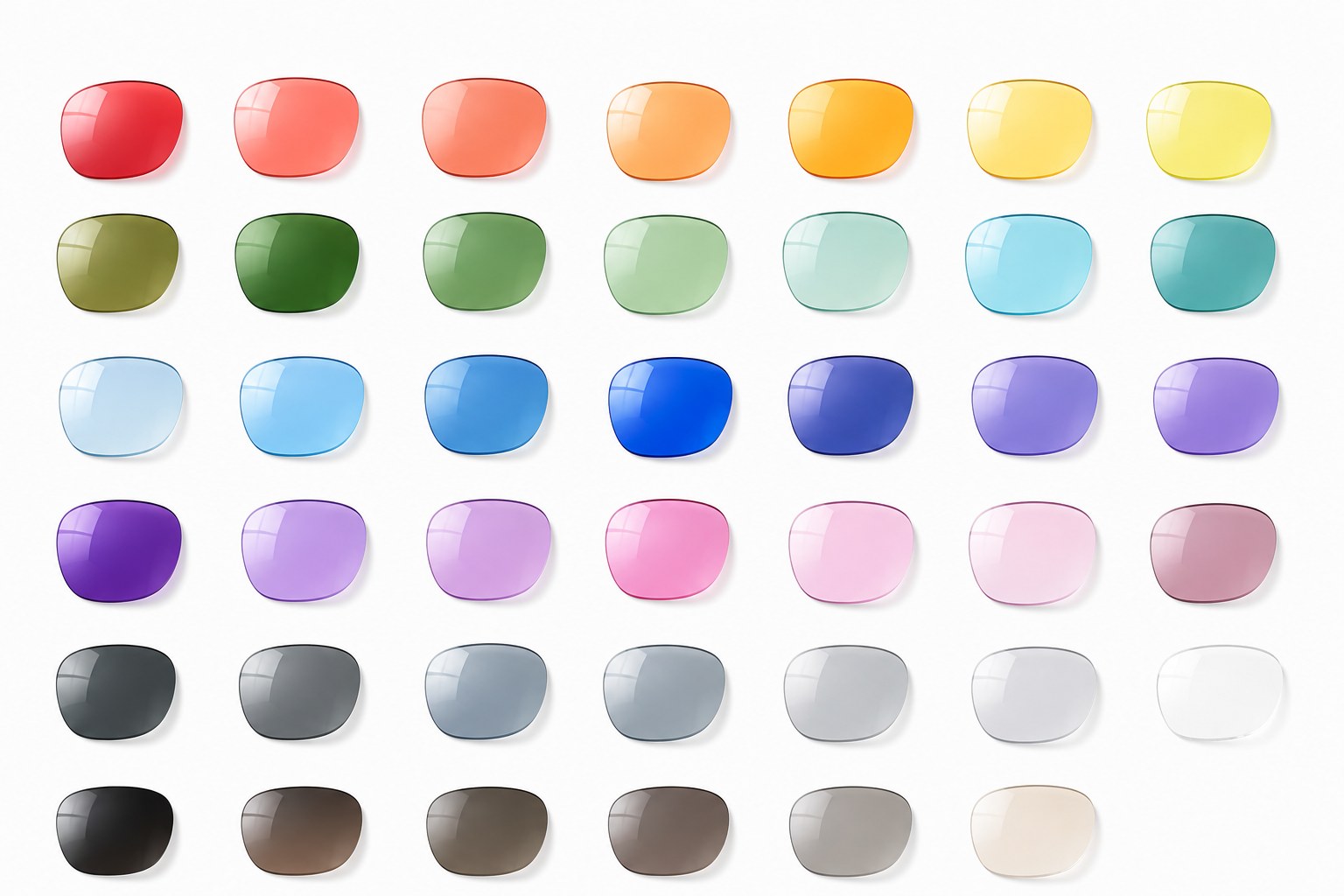
Myopia from 0 to −3.00 D, −3.00 to −6.00 D, beyond −6.00 D; hyperopia; astigmatism; progressives; photochromics; tints; tinted lenses with a prescription; photochromics with a prescription — all of it.
You can of course have us do it. Our prices are below; the two right-hand columns are what the same specification costs at an optician, side by side, for you to judge.
None of the following needs a box ticked on a web page. Leave us a note with the order, or simply photograph your prescription and send it — we will confirm it with you before anything is cut.
Astigmatism.Power and axis, each eye separately.
Myopia plus hyperopia, progressives.Distance above, near below. For anyone who cannot get on with progressives, we suggest two separate pairs.
High prescriptions.We hold the high-index materials they need: 1.67 and 1.74 are both available.
An unusual pupillary distance, or a large difference between eyes.Orders like these have always been made one pair at a time, and we make them.
Any lens colour.Including tinted lenses with a prescription, and photochromics with a prescription.
| Material | Clear blue-light and UV |
Tinted plus 20% |
Photochromic plus 50% |
Chinese optician | US optician |
|---|---|---|---|---|---|
| 1.56 standard resin | from ¥60 | from ¥72 | from ¥90 | ¥100–300 | $50–300 |
| 1.60 MR-8 | from ¥100 | from ¥120 | from ¥150 | ¥200–600 | $100–450 |
| Trivex | from ¥180 | from ¥216 | from ¥270 | ¥400–800 | $150–500 |
| Prescription | Material | Clear blue-light and UV |
Tinted plus 20% |
Photochromic plus 50% |
Chinese optician | US optician |
|---|---|---|---|---|---|---|
| −3.00 to −6.00 D | 1.60 MR-8 | from ¥100 | from ¥120 | from ¥150 | ¥200–600 | $100–450 |
| −5.00 to −8.00 D | 1.67 MR-7 | from ¥180 | from ¥216 | from ¥270 | ¥400–1,000 | $180–600 |
| Beyond −8.00 D | 1.74 MR-174 | from ¥360 | from ¥432 | from ¥540 | ¥800–2,000 | $250–800 |
The optician figures are taken from the published prices of Chinese optical chains and of LensCrafters and Walmart Vision Centers in the United States. They are for comparison only and are not a quotation from any of them. Astigmatism, progressives and an unusual pupillary distance are priced separately — send us the prescription and we will confirm it before cutting.
The set below is an illustration, not the limit of the swatch book. Any colour you can order at a professional optician, this pair can take — including tinted and photochromic lenses with a prescription.
MYSK App is our own. When the hardware arrives, this is the first thing it pairs with — pairing, fetching photographs, fetching recordings, managing the device.
But making pictures, taking notes, keeping records — we do not intend to do all of that ourselves. The platform is open: phone, desktop, even a purely web-based app can join it.
The full list of ecosystem apps will be announced as it grows.
The glasses get the frame down cleanly; making a picture out of it belongs to the people who do that for a living.
It works without a subscription.Shooting, organising and exporting are all free. Only the advanced features need its own super VIP.
No phone out, nothing unlocked, no app opened. The first AI glasses in the world that can pay this way in China, the United States, the Middle East and Southeast Asia at once.
In China, one company has done it.So far only Alipay has made "look, and it's paid" work on AI glasses.
Outside China, none has.Beyond China, no payment app has yet brought this into the AI-glasses setting at all.
We work with Nihao Pay.Everywhere it is supported, this pair can pay that way — China, the United States, the Middle East, Southeast Asia.
Chinese people abroad can use it too.This first run is built for mainland China and the interface is in Chinese only. But you can still buy it from abroad and use Nihao Pay for small no-PIN payments. How we ship overseas is something we work out one to one once you join the community.
It will make you the coolest technology user in the room.
"The first" is what we know as of publication. Which countries and regions actually work is governed by Nihao Pay's coverage.
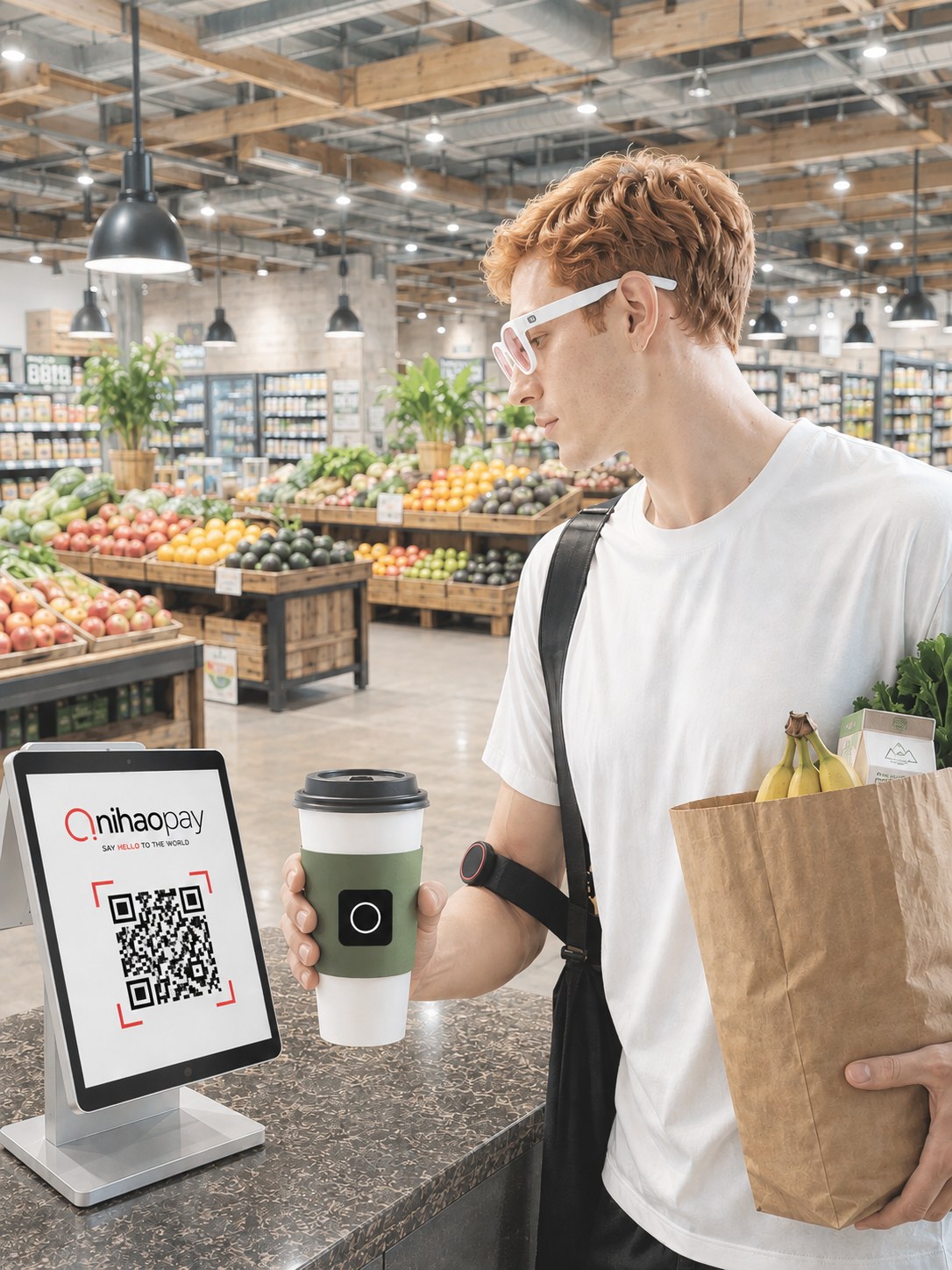
Nihao Pay is an ecosystem app on MYSK.It handles payment, which we do not do ourselves.
MYSK is an ecosystem partner of Nihao Pay.The glasses are a new way into payment for them.
The last section was about what is already in the ecosystem; this one is about how to join it. We publish the interface documentation and a development kit — fetch photographs, fetch recordings, trigger the shutter. What a developer gets is what we use ourselves.
What a pair of glasses can do should not be decided by the people who make glasses. We do not intend to build any of the following, and every one of them is buildable:
Identifying plants and animals in the field.A child sees a plant they do not know on a hillside and presses once. What comes back is an illustrated list of names.
Picture notes.A line or two against every photograph — spoken or typed. A picture and its words together are worth more than either stored alone.
Time outdoors.An application that does one thing: record how long you actually spend outside each day.
A food diary.An hour over a meal, twenty frames, and it becomes a record of what you ate — which can also feed a health analysis.
The developer documentation goes public before shipping. Write to us if you want it early, or if you want your own app in the ecosystem.
¥10 to the Musk Institute.Once per pair sold, with no cap and no sales tier attached.
¥10 into the MYSK stray cat fund.Which grassroots stray-cat rescues the money finally goes to is decided together by the 30 launch partners, and the accounts are public.
Who the launch partners are.Thirty of them. Over the ten weeks from 21 August to 30 October, three a week come from the top of the creator referral leaderboard. They are also trustees of the Musk Institute.
Why it is written on the page.Because writing it down means having to do it. Unwritten, it is only an idea that can be cancelled at any time.
The Musk Institute was founded by Errol Musk, Elon Musk's father. It is not Elon's project, and it has no connection to SpaceX, Tesla or xAI.
It began with a conversation in Dubai in late 2024. Someone asked him what he would do next, and he answered as an engineer: getting rockets right is not enough, there is also travel through space and time and conquering gravity to work on. Someone in the room said: then why not call it the Musk Institute.
Four directions: longevity, fusion, spacetime, gravity.
The idea is not to recruit the scholars with the best CVs, but to find the people the system does not recognise who have strange, original things in their heads — the "undiscovered Faradays". Children included: some of them may be building four-dimensional space in their minds and simply have no language for it yet.
In its first year the Musk Institute admits no students, teaches no courses, raises no funds and runs no commercial activity. The one thing it does is travel the world with Errol Musk: China, Japan, Dubai, Southeast Asia, and a Starship launch watched in the United States.
The first cohort comes entirely from MYSK owners, capped at the first 1,000. The first stop is a tour of China.
The itinerary is organised by the community.How each city goes, where to visit, where to stay, is worked out among the members themselves. We are not a travel agency.
Errol's costs are entirely ours.The platform pays them, and none of it is spread across any member.
It starts in a group chat.Whoever is going to a given stop talks it through beforehand — the route, what to do together locally. On the day, Errol leads.
A place can be transferred.If you cannot go yourself, you can pass the entitlement to someone else.
The place is Starbase, beside Boca Chica beach near Brownsville, Texas. Which launch, and which day, can only be settled close to the time.
We are not fixing a date in advance. SpaceX's schedule keeps moving, and no launch date set a year ahead is believable — we will tell you the moment we can be sure.
The good news is that the cadence keeps rising. "Go to Texas and watch a launch" is far likelier to come off than it was a few years ago, when it meant betting on a window that opened once every few months.
What we cover.Tickets to the launch-viewing party; and we waive the organising fee, the local guide and host costs, the party costs, and the arrangement fee for the private visits.
Who will be at the party.We will invite a number of former SpaceX executives and engineers.
What you cover.Flights, hotel, meals, local transport, visa and insurance.
One thing to be clear about.This is a viewing trip we organise. It is not an official SpaceX event and we are not a partner of theirs. Whether Elon Musk himself attends is outside our control, so please do not treat it as a promise.
Everything above is about the glasses themselves. This section is a consequence: because we made three sizes, the smallest lands exactly on the face of a child of 6 to 12.
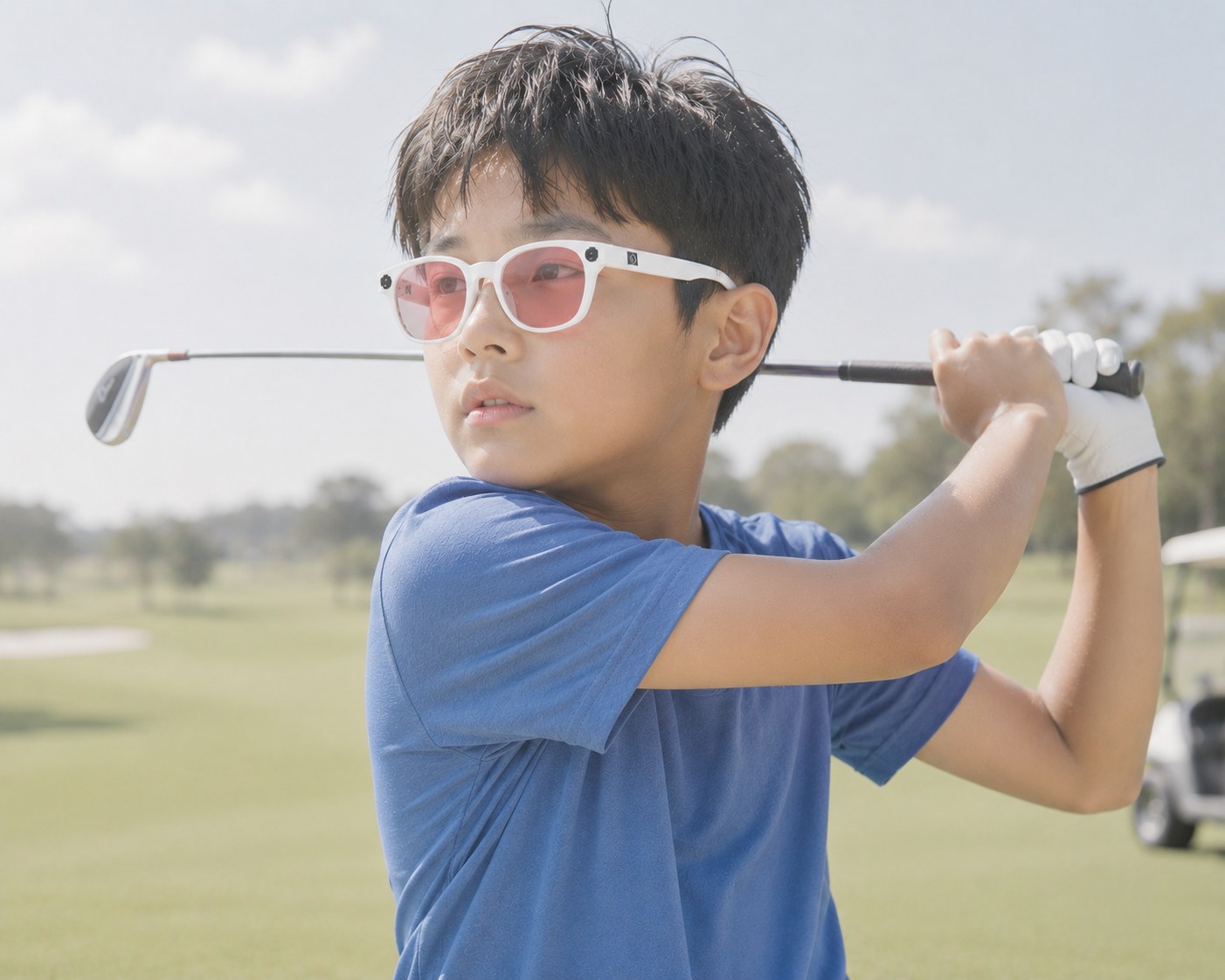
And once it lands there it becomes something else — the first children's AI glasses in the world that both photograph and record offline. Not AR; AI glasses.
We did not build a separate product for it. It is not a children's edition with features cut out; the hardware is identical to the adult sizes.
Cut for a child's face.Narrower frame, narrower bridge, shorter temples, covering ages 6 to 12 and teenagers with smaller heads. Hinges to sports-eyewear standards — on a child's glasses, almost every real breakage happens at the hinge.
It takes a prescription just the same.Plenty of children already wear glasses. Myopia, hyperopia and astigmatism are all fine, and so are photochromics.
Why nobody has done this before.There are children's watches with cameras, and there are children's devices that record. A pair of glasses a child can use outdoors to catch a flower, a bug, a leaf — with nothing at all depending on a network — has not been built yet.
About a child's privacy.The recording captures the wearer and nobody else, in hardware: what your child says is recorded, what the classmate beside them says is not. That is the same answer for a parent and for a school.
So a family of three can each have one.S for the child, M and L for the adults — three of the same glasses, the same functions, each the size that fits.
¥1,250 a pair, retail. The early-bird code is not public — it exists only inside a creator's invite link or code.
Size
AI glasses that photograph, and record with the network gone. Early-bird price during the pre-order.
Retail¥1,250
You pay¥1,250
Pre-orderOpens 21 August 2026
Ships30 November 2026
ColourWhite. The only colour at launch
SizesS / M / L, chosen at checkout, identical hardware
Lens includedPlano light red gold, Trivex, ¥400–800 a pair at an optician
In the boxGlasses, replaceable nose pads, magnetic charging cable, case, cloth
PrescriptionsFrom ¥60, priced by material and power
First 1,000A place in the Musk Institute's first cohort, transferable
Per pair sold¥10 to the Musk Institute, ¥10 into the stray cat fund
ShippingFree nationwide. No packaging or handling fee within mainland China
The early-bird code is not public — it exists only inside a creator's invite link or code. Pay now, ship November 2026. If we are more than sixty days later than that, we refund you without being asked.
Mainland China.Free nationwide, with no packaging or handling fee.
One pair at a time.Many pairs are glazed to an individual prescription, and go out once they are cut. That is not an efficiency problem; it is what the glazing trade has always looked like.
Chinese customers abroad.This first run is stocked in mainland China only. If you are overseas and want one, join the community and we will work out one to one how to get it to you.

A letter from the founder
Founder and CEO
My father owned a chain of electric-motor repair shops. I grew up around copper wire, machines and money. Very early on I was a games trader, moving equipment between platforms.
Later, as an angel investor, I backed the AI company behind Lenovo's smart router and sold part of my stake to Xunlei and JD. That period gave me a first-hand feel for smart hardware, for wearables, and for the word "gateway".
A few months ago a friend doing AI research at OpenAI told me what he needed: to talk to his coding agent anywhere, at any time — not sitting at a desk, but anywhere, in a very quiet voice.
MYSK started from that sentence. It does not think. It simply catches everything you said, whole, and hands it back to you.
— Sima
Three things. It also records offline — with no network at all. The main microphone sits on the lower rim facing your mouth, only 4–7 cm away, so you can speak very quietly. And it comes in three sizes: a single standard size that relies on flexible temples to fit is a reasonable approach — we chose a different path.
One: white. The same white as the classic Apple phone white, made with the same baked finish. Other colours will come, but not in this first run.
One plano light red gold lens in Trivex; the same material is ¥400 to ¥800 a pair at an optician. Another colour, or a prescription, is paid for separately.
Measuring your head is the most accurate. You can also send us the string of numbers printed inside the temple of the glasses you wear now and we will match it. On top of the three sizes there are flexible temples, so the real coverage is a little wider than the table says.
Yes, from ¥60. Myopia, hyperopia, astigmatism, progressives, photochromics, tints and tinted lenses with a prescription are all possible. And because the frame is built on ordinary optical geometry, you can also take it to any professional optician.
No. They are stored on the glasses first and synced later.
Five-second clips, yes. No long video — it is not what glasses are for, it will not fit, it costs far more power, and it shakes for as long as you are walking. For something watchable, use interval shooting cut into a sequence.
In the countries and regions Nihao Pay supports, currently China, the United States, the Middle East and Southeast Asia. The interface in this first run is Chinese only.
MYSK App, our own. It is the first thing the hardware pairs with — pairing, fetching photographs, fetching recordings, managing the device.
The platform is open: phone, desktop and purely web-based apps can all join. The glasses get the picture and the sound down cleanly, and the rest goes to whoever does that thing for a living. The full list will be announced as it grows.
No. Shooting, organising and exporting are free; only the advanced features need its own super VIP.
No. One microphone faces your mouth and one faces away, and the decision is the difference in level between them; someone half a metre away never reaches the threshold. This is not a software filter — it is where the ports are.
The camera faces what is in front of you, the same as your own eyes. It is meant for outdoors and for being on your own. Please respect the rules of wherever you are — exam halls, secure sites and some museums do not allow camera devices.
Among AI glasses of this class it is one of the lightest. The three sizes do not weigh the same: S is the lightest and L the heaviest. We will publish the measured figure for each size before shipping.
Because on a sensor this small, the more pixels you pack in the less light each one catches, and both low-light noise and dynamic range get worse. We spent that budget on a larger pixel instead. A 4K photograph out of 12 megapixels is more than enough on a phone, on a social platform, or printed at six inches.
What a flagship phone chip is good at is running a large model on the device itself, and our AI is on the phone, not on the glasses. What the glasses want is a chip that gets the frame down clean: AI-ISP, phase-detect focus, electronic stabilisation — it has all of them. The cost and the power we did not spend went into the sensor, the lens and the battery.
A place in the Musk Institute's first cohort: travelling the world with Errol Musk — first a tour of China, then Japan, Dubai, Southeast Asia, and a Starship launch in Texas in the summer of 2027. The itinerary is organised by the community, Errol's costs are ours, and your own flights, hotels and visa are yours. The place can be transferred.
The interface documentation and a development kit — fetch photographs, fetch recordings, trigger the shutter. The documentation goes public before shipping.
The glasses are bought once. There is no monthly fee.