Lenses

Any optician can glaze it.

Because the frame is built to a traditional optical structure, not sealed around a lens only we can supply.

MYSK · Prescriptions from ¥60 · One plano light red gold Trivex lens included

A traditional optical structure · It is not a sealed part.

On most AI glasses the front is designed around the electronics: the lens presses into a channel made for it, or is moulded into the structure outright. That is a reasonable way to do it, and it lets the body be more compact. We took the other road.

Our front is built to a traditional optical structure. The rim, the groove and the screw positions are the same ones the optician down your street handles every day on ordinary glasses.

Which means: walk into any professional optician with it, and everything they can make for a pair of glasses, they can make for this one. We cut it, or they cut it. Either is fine.

That road is not free. Keeping the traditional structure means the cabling has to route around the rim, and we spent a good deal of effort inside the temples on exactly that. We think the trade is worth it.

What can be made · Whatever a professional optician offers.

Myopia.0 to −3.00 D, −3.00 to −6.00 D, beyond −6.00 D, each eye separately.

Hyperopia.Every power. The kind that starts in your thirties with small print; there is a whole section on it below.

Astigmatism.Power and axis, each eye separately.

Progressives.Distance above, near below. One pair of glasses for two jobs.

Photochromics.Clear indoors, sunglasses outside, with nothing to do. Available with a prescription too.

Tints.Any colour. Available with a prescription too.

High-index materials.1.60, 1.67, 1.74 — whatever a strong prescription needs.

An unusual pupillary distance, or a large difference between eyes.Orders like these have always been made one pair at a time, and we make them.

What it costs · From ¥60, by material and power.

The clear column includes blue-light and UV coatings. Tints are 1.2x the clear price and photochromics 1.5x. The two columns on the right are what the same lens costs at a high-street optician, side by side, for you to judge.

0 to −3.00 D

Material Clear
blue-light and UV
Tinted
plus 20%
Photochromic
plus 50%
Chinese optician US optician
1.56 standard resinfrom ¥60from ¥72from ¥90¥100–300$50–300
1.60 MR-8from ¥100from ¥120from ¥150¥200–600$100–450
Trivexfrom ¥180from ¥216from ¥270¥400–800$150–500

Beyond −3.00 D

Prescription Material Clear
blue-light and UV
Tinted
plus 20%
Photochromic
plus 50%
Chinese optician US optician
−3.00 to −6.00 D1.60 MR-8from ¥100from ¥120from ¥150¥200–600$100–450
−5.00 to −8.00 D1.67 MR-7from ¥180from ¥216from ¥270¥400–1,000$180–600
Beyond −8.00 D1.74 MR-174from ¥360from ¥432from ¥540¥800–2,000$250–800

None of these amounts is bought on this site; they are here to help you judge, not to be added to a cart. The Chinese figures are taken from the published prices of Chinese optical chains; the US column merges the published prices of LensCrafters and Walmart Vision Centers into a single range. For comparison only, and not a quotation from any of them. Astigmatism, progressives and an unusual pupillary distance are priced separately — we confirm the final figure with you before anything is cut.

When you order · One prescription slip is enough.

Sphere, cylinder and axis, for each eye.Written on the slip as SPH, CYL and AXIS.

Pupillary distance.Written on the slip as PD. Your optician has it, and most slips print it.

Whether you want this prescription clear, tinted or photochromic.Any of them is fine.

If you are unsure, do not choose yet.Leave a note with the order, or simply photograph the slip and send it to us, and we will confirm before cutting.

Write to us

Using your own optician · Tell them these three things.

It is a TR90 front in ordinary indoor-eyewear proportions.Not the wrap curvature of sunglasses; treat it as a normal job.

Do not force the rim open while the temples are attached.The electronics live in the temples, and that is not where the load should go.

The lens is a structural part.The main microphone port and its cable channel are moulded into the front, and the rim needs a lens in it to hold shape. Do not leave it empty for long, coming out or going in.

Having it glazed elsewhere changes nothing, and costs you nothing in support from us.

On long-sightedness · At thirty-eight, the small print goes.

You think it is the late nights. You think you have not slept enough. In fact you may already be slightly long-sighted.

For some it starts at thirty-eight, for others at forty-five, for others at fifty; the spread between people is wide. The awkward part is this: if you need a prescription in your thirties or just past forty, you do not want anyone thinking you are wearing reading glasses.

But what you are wearing is a pair of AI glasses. That changes the whole thing.

How to find out your power

Get tested at an optician; that is the accurate answer. Or something simpler: try the ready-made pairs in a shop, and whichever feels comfortable is the one that suits you. Long-sighted powers move little over time, and differ little between people — which is where it is quite unlike myopia.

The real problem is that if you never wear them, you never notice. Losing the small print does not arrive as the thought "I should get glasses". It arrives as a slowness seeping into your work, your reading and your life: the menu read twice, the manual skipped, the phone's type size creeping up, evenings of reading that tire you more than they used to.

Progressives, or two separate pairs

Progressives are available: distance power above (or plano), near power below. One pair of glasses for two jobs.

But some people simply cannot get on with progressives — the edges of vision swim, and stairs need a tilt of the head to find the angle. So there is another way to do it: two pairs, one for distance and one for near. Plenty of people end up choosing that.

Photochromic · Clear indoors, sunglasses outside.

From ¥90, which is 1.5x the clear lens of the same specification. Molecules in the lens change shape when ultraviolet reaches them; the changed shape absorbs visible light, and the lens darkens. Take the ultraviolet away and they relax back, and the lens goes clear again. No power, and no switch.

Why it suits this pair in particular

You walk through a doorway wearing it and never have to choose between shade and hearing; and you never push the frame up onto your forehead — which matters more here than on ordinary sunglasses, because the moment you push it up, the main microphone leaves your mouth.

It is not a gradient, and that is the point

We asked a lot of fashion creators what they made of gradient lenses, and the answer was consistent and blunt: a gradient reads as middle-aged. It is a permanent band of dark, and it is in every photograph of you.

Photochromic is the same idea without that baggage. Most of the time it is a clear lens; when there is sun, it is a pair of sunglasses. Nothing about it is permanent.

What it cannot do

Behind a car windscreen it barely darkens at all.Laminated glass blocks most of the ultraviolet, so the lens never gets the signal. If you mostly want it while driving, order a fixed tint instead.

Temperature changes it.Cold weather makes it darker and slower to clear; hot weather stops it reaching its darkest, but it clears faster.

It does not go completely clear indoors, and keeps a trace of colour.

Why not polarised · Because you will look at your phone.

A polarised lens filters out light reflected off a flat surface at a particular angle — water, wet road, the bonnet of a car. That is genuinely useful for fishing and for driving, and it is why polarisation is sold almost everywhere as the premium option.

It is also exactly what makes it wrong here. Phone and laptop screens emit polarised light.Put a polarising lens in front of one and the screen dims; turn your head and at some angles it goes black. Every time you pull a photograph off, every time you scroll the album, every time you change a setting, the lens is working against you.

Polarisation was made for people looking at water. This is a product made for people looking at a phone.

A UV400 tint blocks the same ultraviolet at half the cost of polarisation, and it leaves your screen alone.

A dangerous misreading · Dark is not protection.

Ultraviolet protection has nothing to do with how dark a lens looks. It comes from a UV400 coating or from the lens material itself. Darkness is comfort, protection is chemistry, and the two are independent.

Which produces a genuinely harmful failure. A lens that is dark but does not block ultraviolet is more dangerous than wearing nothing: the darkness makes the pupil open, and an open pupil lets more ultraviolet reach the back of the eye than an unshaded, contracted one would.

The cheap pairs on a street stall are usually exactly this. They look like protection while doing the opposite, and holding one up to the light will not tell you.

Every MYSK lens is UV400 — the one in the box, and any prescription lens we cut. There is no version of this product where protecting your eyes is the upgrade.

On colour · We recommend a light one.

You can have any colour; that does not change. But if you ask our opinion, we will say pick a light one, for two reasons.

Indoors you cannot take it off.You might be on a call, or halfway through listening to something. Taking the glasses off means cutting that off, and forcing someone in a doorway to choose between hearing and seeing is a miserable thing to do. So the lens has to hold up under a ceiling light, and a dark one does not.

Outdoors you still look at your phone.Pulling photographs off, scrolling the album, changing a setting — all of it happens outdoors, in sunlight, on a screen. A dark lens pushes the glasses onto your forehead every single time — and the moment you push, the main microphone leaves your mouth. A light lens shades your eyes without shading your screen.

And one that is less obvious: glasses usually start looking cheap at saturated colours.True blue, true green, true yellow — any of them can read as plastic in poor light, whatever they actually cost to make. Light colours have no such failure mode.

The lens in the box · One plano light red gold.

Every pair comes with one plano light red gold lens, in Trivex, at no extra charge. The aim is for these glasses — white frame, light red gold lens — to become the mark of our community, and its culture.
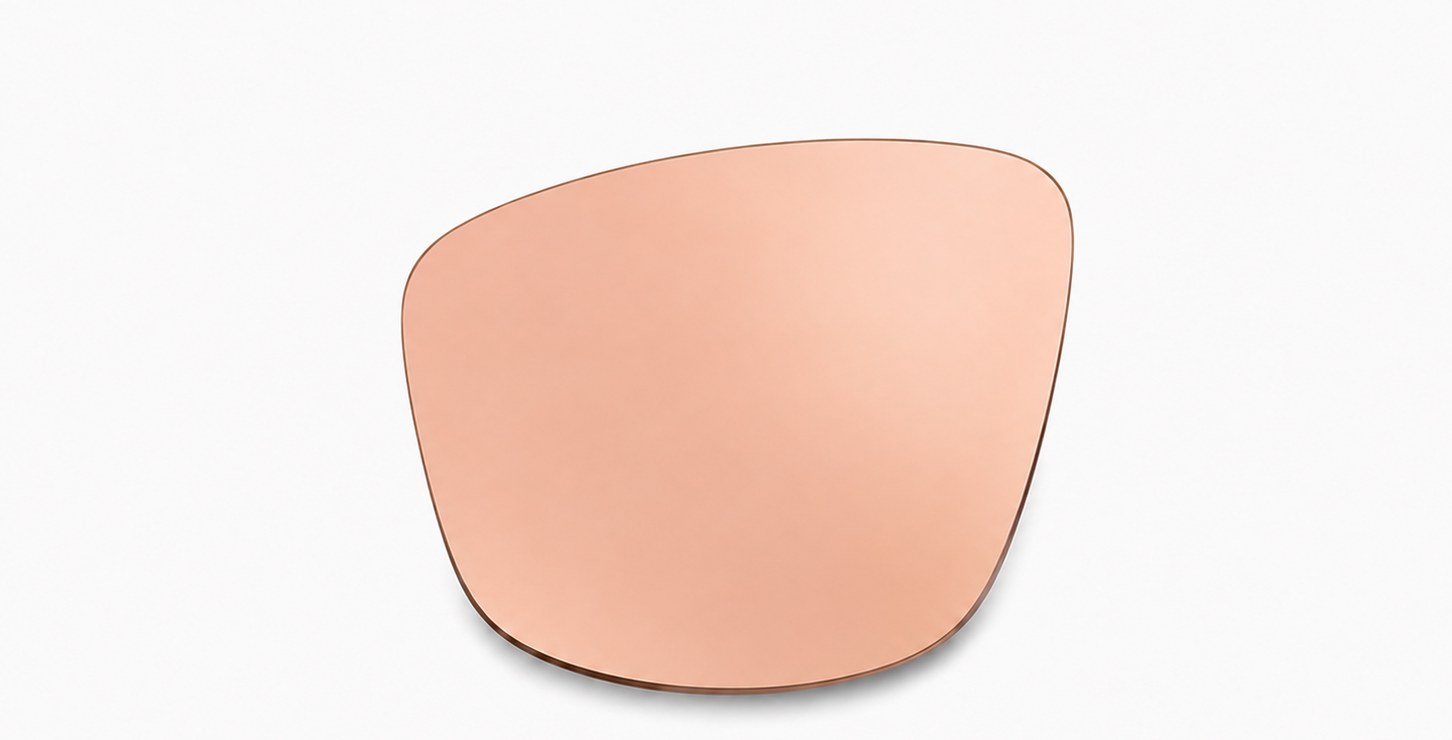
The plano light red gold lens that comes with the MYSK

It is Trivex.One of the finest materials in eyewear today. The best there is for impact, which is why American children's and sports eyewear uses so much of it; and lighter than ordinary resin, with less optical distortion.

A lens in this material runs ¥400 to ¥800 a pair at a high-street optician.Which is to say that the included lens alone is worth ¥400 to ¥800.

Why light red gold.Warm, young, current. In testing, a very light warm tint makes the whites of the eyes whiter and the gaze clearer — an effect that is not for you. You cannot see it in a mirror; the person sitting opposite you can.

One lens included, with no alternative to pick from.Any other lens colour, or a prescription, is paid for separately. That is deliberate: first let the white frame with light red gold become the pair everyone recognises on sight.

Care · Rinse first, then wipe. Never dry.

The most common way a lens gets scratched is being wiped while dust is still on it, which grinds the dust across the coating. Rinse under cool water first, then dry it with a cloth. Do not use alcohol or household glass cleaner; they strip the coating.

Another habit worth breaking: do not leave the glasses on a car dashboard.Heat softens TR90 and the frame distorts, and a distorted frame moves the main microphone away from your mouth — that one distance is what this whole product depends on.

The microphone port is a very small hole with a metal mesh behind it. The day a recording sounds muffled, look at that hole on the lower edge of the left rim first. Rinse it; do not poke anything into it.

Lens questions · Short answers.

Can I take it to my own optician?

Yes, and it changes nothing. Take the frame in and tell them it is a TR90 front in ordinary indoor-eyewear proportions. Ask them not to force the rim open while the temples are attached — that holds at any shop.

What is the least a prescription pair can cost?

From ¥60, for 1.56 standard resin single vision. A stronger prescription needs a higher index, and the price follows the material. Tints are 1.2x the clear price and photochromics 1.5x.

Can you do astigmatism and progressives?

Yes. Astigmatism, progressives, high index, an unusual pupillary distance and a large difference between eyes are all possible, quoted individually from the prescription.

Can I buy a second set of lenses later?

Yes. The electronics all live in the temples, so a second set of front lenses costs what the lenses cost. Keep one set tinted and one photochromic, and swap them by season.

Are the lenses impact resistant?

The lens in the box is Trivex, the standard impact-resistant material for sports and children's eyewear. The frame is TR90 nylon, which springs back under load rather than snapping.

Does it work with no lenses fitted?

Electrically it does, but do not do it. The main microphone port and its cable channel are moulded into the front, and a rim with no lens supporting it will distort. The lens is a structural part here.

Which lens comes in the box?

One plano light red gold lens, in Trivex, at no extra charge. That is the only one included and there is no alternative to pick from — the aim is for the white frame with the light red gold lens to become the mark of our community, and its culture. Any other colour, or a prescription, is paid for separately.

Do the lenses filter blue light?

Yes. The lens in the box and every prescription lens we cut carry blue-light and UV coatings.

What we are guarding against is artificial blue light. Blue light from the sun does people good, and at night there is none of it anyway, so it does not touch melatonin; the short wavelengths that cause trouble are the artificial ones. Some lenses on the market claim to filter the harmful blue light and keep the beneficial blue light, separating them by wavelength — the biohacker and longevity community in the United States does not accept that account, and holds that artificial blue light is bad for the body whatever its wavelength. This is the position we have adopted, and it should be said plainly that it is not a settled medical conclusion.

What colour is the frame at launch?

White, and only white. The same white as the classic Apple phone white, made with the same baked finish.

All the answers · 102 questions